- Teacher: Matthieu Heller
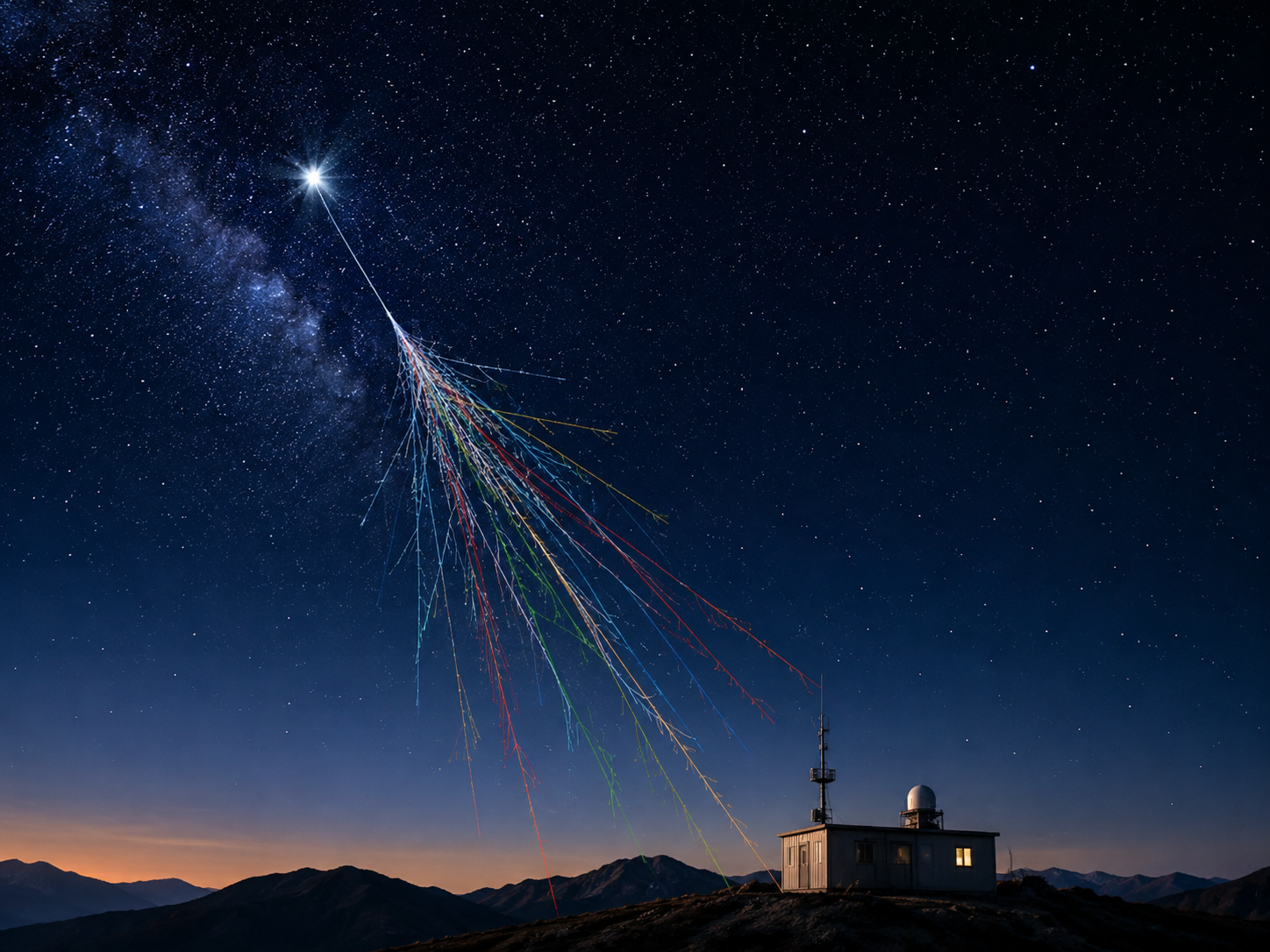
In this laboratory, students investigate atmospheric muons originating from the interaction of cosmic rays in the atmosphere. They measure two of their fundamental properties: their lifetime and their mass.
Beyond obtaining these quantities, the main objective is to develop a rigorous experimental approach: understanding how a physical quantity can be translated into an observable, how a detector and its electronics produce and record a signal, and how calibration, instrumental effects and statistical uncertainties ultimately affect the measurement.
Using scintillators, photodetectors and modern data-acquisition electronics, students become familiar with the complete experimental chain, from signal generation and conditioning to data acquisition, calibration and analysis. Particular attention is given to the critical assessment of the measurement, the estimation of uncertainties, and the comparison of experimental results with expectations.
Numerical simulations with Geant4 complement the laboratory work and provide an important link between the underlying physics and the measured observables. They are used to reproduce the experiment, study systematic effects and validate the interpretation of the data. Through the measurements of the muon lifetime and mass, students therefore experience the different stages of a modern particle-physics experiment and learn how a quantitative physics result is progressively constructed from experimental data.